
Fatherhood Resource
// FATHERHOOD STATISTICS
Fatherhood matters.
Not just in theory, not just emotionally, but in measurable, well-documented ways.
At The Intentional Father, we believe in equipping men with truth and that means anchoring our conversations in real data. Below is a summary of peer-reviewed research and government data that underscores the profound impact fathers have on their children's lives.
Quick Links:
Father Absence in the United States
According to the U.S. Census Bureau (2022), 1 in 4 children—roughly 18.4 million—live without a biological, step, or adoptive father in the home.

Mental Health and Emotional Well-Being
Many studies have correlated a father's lack of involvement with decline in mental health and emotional stability of their children.
The Early Childhood Longitudinal Study (ECLS) reported that children with high levels of father involvement showed fewer depressive symptoms and higher self-esteem at age 6. (Cabrera et al., 2007. Father Involvement and Children’s Functioning at Age 6 Years: A Multisite Study.)
A study published in BMC Psychiatry in 2017 examined over 4,500 Chinese children and found that children with absent parents—particularly fathers—had significantly higher rates of suicidal ideation, mediated by depression and anxiety. (PMC5720745)
Involved fathers are associated with children having stronger peer relationships, greater emotional regulation, and fewer behavioral problems.
A comprehensive Swedish study published in the American Journal of Psychiatry in 2021 analyzed data from 2.4 million individuals and found the following:
-
Suicide attempt rates:
-
2.8% in intact nuclear families
-
6.3% in families where the biological father did not live in the home
-
5.5% in stepfather families
-
6.7% in adoptive families
-
This study emphasizes that children raised without their biological fathers are more than twice as likely to attempt suicide.

Teen Pregnancy
Research indicates that father absence is significantly associated with an increased risk of teenage pregnancy.
A 2003 study titled "Does Father Absense Place Daughters at Special Risk for Early Sexual Activity and Teenage Pregnancy?" found that girls who experienced father absence were at a significantly higher risk for earlier sexual activity and teegage pregnancy. Specifically, girls whose fathers left early in their lives were about five times more likely to become pregnant during adolescence compared to those whose fathers were present.
The same study indicated that the timing of a father's departure plays a role. Earlier father absence correlates with a higher risk of teenage pregnancy.
Additional research supportes these finding as well, suggesting that fathers absence is linked to accelerated reproductive development and increased sexual risk-taking in daughters.

Juvenile Incarceration
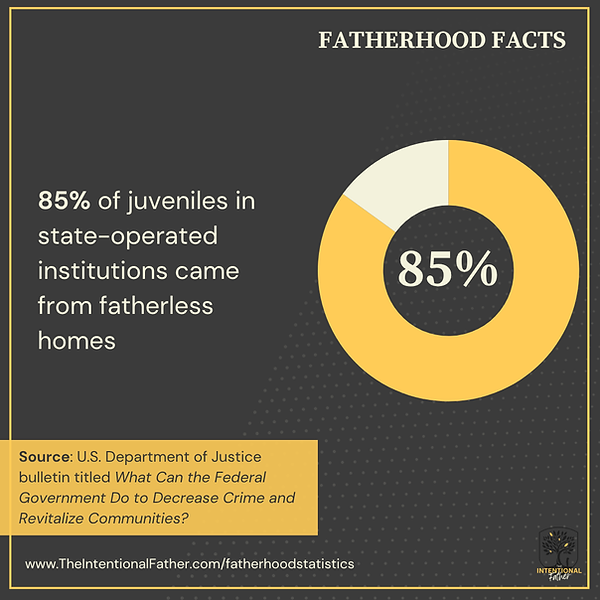
According to a U.S. Department of Justice bulletin titled "What Can the Federal Government Do to Decrease Crime and Revitalize Communities?", approximately 85% of all youth in prison come from fatherless homes. While this bulletin was released in 1998, the staggering statistic highlights the crucial connection between father involvement and juvenile delinquency prevention. Unfortuntely, a more recent study specific to parental status of juvenile incarceration has not been completed.
However, in general and in many more recent studies, father absence has been repeatedly linked to higher rates of aggression, violence, and criminal behavior among adolescents.
In addition to father absence, research shows that it’s not just the presence of a father that matters—but the quality of the relationship.
A 2018 study published in the Journal of Adolescence found that boys who had harsh, emotionally distant fathers were more likely to engage in criminal behavior than those with absent fathers. In contrast, fathers who provided warmth, structure, and emotional support had a protective effect.
Similarly, a 2009 meta-analysis in the Journal of Abnormal Child Psychology revealed that low paternal involvement—especially in the form of poor communication, neglect, and lack of supervision—was strongly linked to increased delinquency in youth, particularly in boys.
These findings underscore a powerful truth: when fathers are involved in truly a present and intentional way, they play a critical role in keeping kids out of trouble and helping them thrive.
Educational Outcomes
While it is easy to get caught up in the negatives of a father's absence, on the bright side, there are also many studies that link a father's active involvement with positive outcomes.
A study published in the Journal of Marriage and Family titled "A Matter of Time: Father Involvement and Child Cognitive Outcomes" found that fathers who engage in educational activities with their children (such as reading and helping with homework) are associated with moderate to large improvements in cognitive functioning.
Children with involved fathers are twice as likely to go to college, according to a longitudinal study by the U.S. Department of Education. The report found that father involvement correlated strongly with academic persistence and college attendance.
Children with engaged fathers tend to score higher on standardized tests and are more likely to enjoy school and participate in extracurricular activities.
In a study titled "Fathers' involvement and children's development outcomes: a systemic review of longitudinal studies" researchers reviewed 24 publications, focusing on various dimensions of father involvement, including accessiblity (cohabitation), engagement, and responsibility. Out of the 24 studies, 22 reported positive effects of father involvement on their children's development. In addition, the benefits of father involvement were observed across different socioeconomic statuses and were not limited to biological fathers alone.

Final Thoughts
In light of the evidence, one truth stands unshakable: Fathers Matter.
The data is clear—when dads are physically present and intentionally engaged, children thrive emotionally, academically, socially, and even physically.
Conversely, father absence is linked with increased risks of depression, suicide, incarceration, and poor academic performance. These aren’t just numbers; they represent real lives—real sons and daughters who flourish when their fathers show up with intention, love, and consistency.
At The Intentional Father, we believe this calling isn’t reserved for the perfect, but for the faithful. Your presence today could be the difference in your child’s future tomorrow.
So lean in, lead well, and never underestimate the impact of simply being there.